Summary
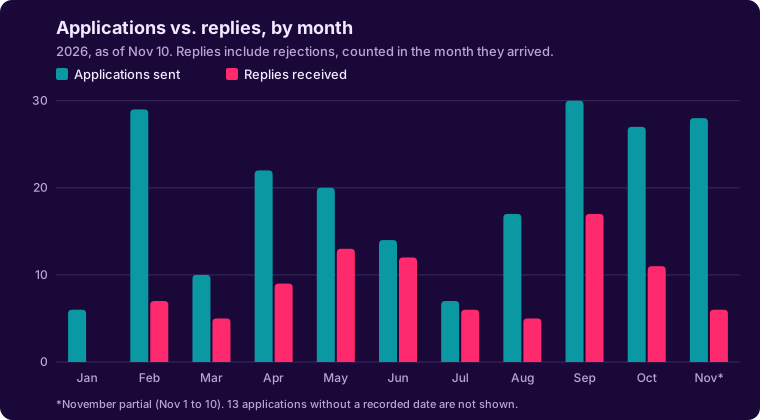
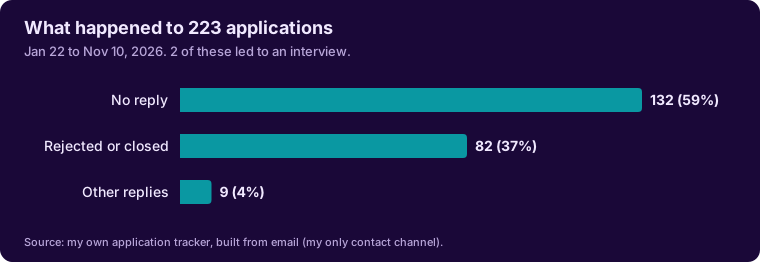
Since I was laid off in January 2026, I've tracked every job application I've sent. As of November 10, 2026: 223 applications, 2 interviews, 82 rejections, and 95 applications with no reply at all after 30+ days.
The biggest pattern isn't fast rejection. It's silence. I've worked in IT for 17+ years, most recently in identity and access management, including access reviews for SOC 2 and ISO 27001. From that side, this looks like a familiar problem: an automated control that nobody is checking.
The numbers
My tracker is built from my email, which is the only channel employers have used to contact me. All figures are as of November 10, 2026.
| Outcome | Count |
|---|---|
| Applications sent | 223 |
| Interviews | 2 |
| Rejected or closed | 82 |
| No reply yet | 132 |
| No reply after 30+ days | 95 |
| Other replies (viewed notices, a recruiter call, a questionnaire) | 9 |
What surprised me is how few rejections were fast. Only 3 came within a day of applying. The median was about two weeks. Most applications go into a system and nothing ever comes back.
Why I think it's a controls problem
I found a few studies from universities and tech firms that back this up. The largest, from Harvard Business School and Accenture, surveyed more than 8,000 workers and 2,250 executives in the US, UK and Germany. Most employers in that study agreed that qualified candidates are screened out because they don't match the exact criteria in the job description. They know, and many keep using these filters anyway.
My best guess is that wording is a real trap in IT. Microsoft renamed Azure AD to Entra ID. Some postings say M365, others say Office 365, others spell out identity and access management instead of IAM. A filter set to match one exact term can reject someone who has done that work for years, just because they wrote it the other way.
Volume and ownership
In my experience, a lot of it comes down to volume and ownership. I see it daily on LinkedIn: a posting I'm interested in went live less than an hour ago and already shows 100+ clicks on apply, from people, bots or AI agents applying on someone's behalf. Many likely never finish. Still, it's almost enough to make me not bother. But I apply anyway. And matching my resume and cover letter to each one takes real time. Even with AI and a fill-in-the-blank template I created, I still proofread every one.
I suspect recruiters are handling more applications than ever, often with smaller HR teams, or with screening outsourced to agencies and third-party firms that don't know the role or the team. Automation fills the gap, but nobody owns the outcome.
Some places now require employers to disclose when AI is used to screen applicants. Ontario has required it in job postings since January 2026 for employers with 25 or more employees. But disclosure isn't oversight. New York City requires bias audits of automated hiring tools, and a 2025 state audit found that enforcement has been weak.
What I'd check
If this were an access control, I believe an auditor would flag it. Here's what I'd check first:
- Test the filter with a resume you know is qualified
- Track pass rates and response times
- Review a sample of rejected applications
- Answer every applicant, even with an automated reply
- Give the process a clear owner
I don't think any of this needs new technology. It needs someone to look.
What I'm doing about it
I use each posting's exact terms and write both versions where they differ, like "Microsoft Entra ID (Azure AD)". And where I can, I look for a referral or reach out to the hiring manager directly.
Sources
- Harvard Business School and Accenture, Hidden Workers: Untapped Talent (opens in a new tab) (2021)
- HBS Working Knowledge, How to Tap the Talent Automated HR Platforms Miss (opens in a new tab)
- Osler, AI in hiring: Ontario employers grappling with new job posting disclosure requirement (opens in a new tab) (2026)
- Office of the New York State Comptroller, Enforcement of Local Law 144: Automated Employment Decision Tools (opens in a new tab) (2025)